Private 1-on-1 3×3 coaching · Kids & teens ages 8–17
Your Child Keeps Practicing. So Why Are Their Cubing Times Still the Same?
What if the answer isn't more practice — but discovering what is actually slowing them down?
You've probably seen it before.
Your child picks up their cube.
They scramble it, start the timer, solve it, and try again.
They watch another tutorial. Learn another algorithm. Spend another evening practicing.
They're doing everything they think they're supposed to do.
But a week goes by.
Then another.
And the numbers on the timer barely change.
Perhaps you've noticed the disappointment on their face.
You want to encourage them. You want to help.
But unless you understand speedcubing yourself, how are you supposed to know what's going wrong?
Here's something worth considering.
The problem may not be how hard your child practices. It may be what they're practicing.
After more than 16 years of cubing, I've learned that turning faster is only one part of becoming a faster cuber.
Sometimes, the time being lost has very little to do with how fast their fingers move.
Let me show you.
Hi, I'm Sam.
I'm the founder of Cube Confidence Club.
I've spent over 16 years developing my cubing skills, and I now work privately with young cubers to help them improve.
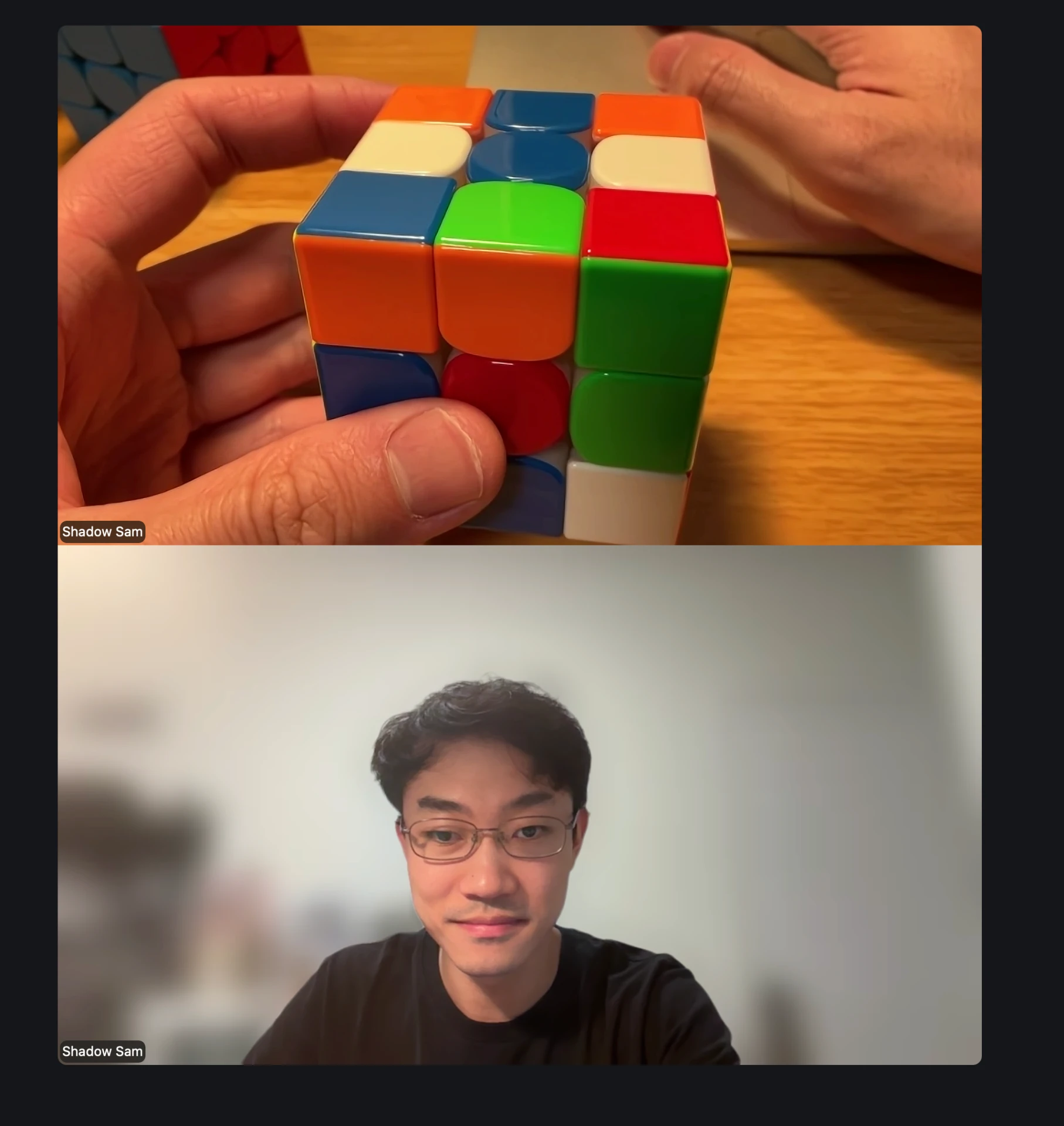
I started competing in 2012. My competition experience includes the 2015 Chinese National Championship, the 2016 and 2018 Asian Championships, and the 2019 World Championship.
When I watch a child solve a cube, I don't just look at the final time.
I look at what happens between the beginning and the end.
Where do they hesitate?
Which movements are unnecessary?
Are they recognizing the next step quickly enough?
Are they practicing the skills that would make the biggest difference to their current solving time?
These are the kinds of details that a timer alone cannot tell you.
And until your child understands where their time is going, it can be difficult to know what to practice next.
Before We Try to Make Your Child Faster, We Find Out What's Making Them Slow.
Think about two children who both solve the cube in 40 seconds.
One might spend too much time looking for the next piece.
The other might recognize pieces quickly but use inefficient moves.
Their times are the same. Their problems are different.
So why should they follow exactly the same training plan?
That's one of the limitations of learning entirely through online tutorials.
A video can show your child what to do.
But it cannot watch your child solve, identify their individual mistakes, or decide what they need to practice next.
That's where personalized coaching comes in.
My coaching approach focuses on three connected steps: Diagnosis, Deliberate Practice, and Automation.
First, Diagnosis.
Right now, most kids plateau because they're practicing everything and improving at nothing.
We pinpoint the exact bottlenecks holding your child back — the cross, F2L (the 'first two layers' stage, where corner and edge pieces are paired and placed), recognition, pauses — so every minute of practice has a clearer purpose.
Then, Deliberate Practice.
Instead of repeating random solves and hoping to get faster, your child receives a targeted practice plan built around their weakest links.
This is how we turn effort into measurable improvements in solving times.
Finally, Automation.
Knowing the right technique is one thing. Being able to use it automatically during a timed solve is another.
We practice until the right techniques become second nature, helping your child develop lasting skills, solve more consistently under pressure, and continue improving independently.
Instead of wondering what to practice every day, your child has a clearer direction.
And you don't need to understand complicated cubing algorithms to support them.
Let's Find Out What's Holding Your Child Back.
Before deciding whether private coaching is right for your child, I'd like to invite you to a free, personalized 45-minute online cube assessment.
During our assessment, we'll explore:
- Your child's current cubing ability.
- Their goals and the challenges they're experiencing.
- Potential areas that may be slowing them down.
- What they could focus on next to improve.
- Whether personalized coaching would be a good fit.
You don't need to know how to solve a 3×3 cube yourself.
You don't need to purchase a coaching package.
And there is no obligation to enroll afterward.
Simply book a time, bring your child's 3×3 cube, and let's take a look at how they solve.
45 minutes · Online · Free · No obligation to enroll
Choose a time and enter your contact details securely in the booking calendar.
Imagine Your Child Finally Knowing What to Work on Next.
Instead of repeating the same solves and hoping for a different result, they can approach practice with a purpose.
They can work toward individual goals.
They can receive feedback on their own solves.
And they can see how their skills develop over time.
Results vary by student, practice consistency, and starting ability.
A Little Clarity Before You Book.
Your Child May Not Need to Practice Harder.
They may need to practice differently. Let's find a clearer next step together.
— Sam