3x3 Cube Notation Guide: How to Read Cube Algorithms
A clear 3x3 cube notation guide covering face turns, primes, doubles, slice moves, and cube rotations so young solvers can read algorithms with confidence.
· 7 min read
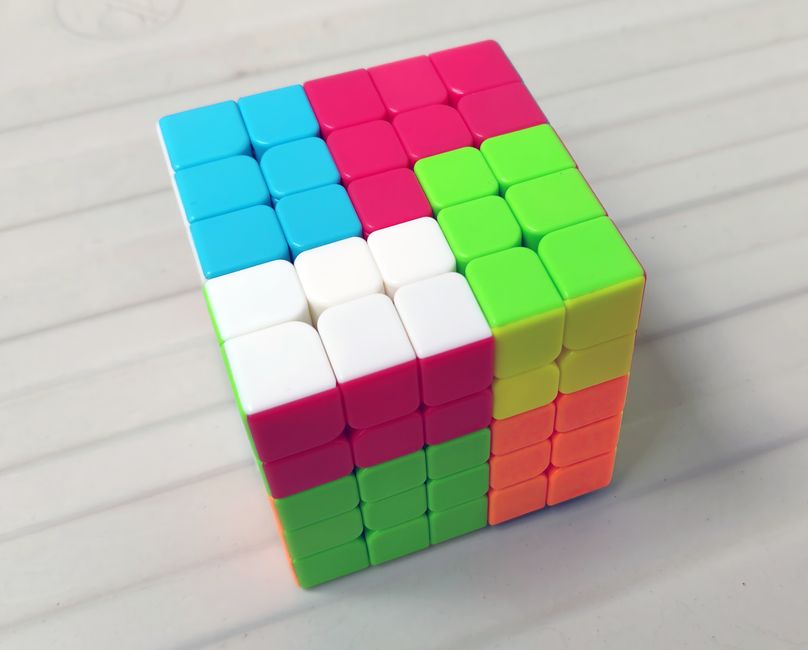
Many new solvers hit the same wall. You find a set of moves online that is meant to solve a case, and it looks like this: R U R' U' F' U2. Nothing about that string is obvious the first time you see it. Yet the basic notation system is remarkably consistent. Learn the core symbols once and a much wider range of tutorials, algorithm sheets, and scramble generators becomes readable.
Most modern 3x3 notation is based on the Singmaster system, originally developed by David Singmaster and extended over time with conventions for moves such as wide turns and whole-cube rotations. That shared notation is why a solver in Toronto can follow a tutorial written by someone in Tokyo without translating every move into words. This guide covers the letters, the symbols, and the small details that often trip up beginners.
What Notation Actually Does
Notation is a written language for describing cube turns. Cubers call a sequence of moves an algorithm, and in a basic move sequence you read the symbols from left to right in order.
Each of the six basic face letters tells you which face to turn, with an unmodified letter meaning a 90-degree clockwise turn as viewed directly from that face. From there, primes, double turns, wide moves, slice moves, and rotations extend the same basic notation system.
Notation serves three jobs in practice:
- It scrambles the cube in a repeatable way, so two solvers can start from the same state.
- It records algorithms that solve specific cases you will meet again and again.
- It lets solvers record and review move sequences in a consistent format, which makes practice and solve analysis easier to share.
Without a shared notation, those tasks would be much harder to communicate precisely. You would have to describe every turn in words instead of using a compact sequence of symbols.
The Six Main Letters
There are six main letters, one for each face of the cube. They are always capitalised.
| Letter | Stands For | What It Means |
|---|---|---|
| U | Up | Turn the top face 90 degrees clockwise |
| D | Down | Turn the bottom face 90 degrees clockwise |
| L | Left | Turn the left face 90 degrees clockwise |
| R | Right | Turn the right face 90 degrees clockwise |
| F | Front | Turn the front face 90 degrees clockwise |
| B | Back | Turn the back face 90 degrees clockwise |
The word clockwise can be confusing at first because a cube is three-dimensional and you are usually viewing several faces at once. The rule is straightforward: each uppercase face letter is interpreted as if you were looking directly at that face. If you were staring straight at the front face, F would be a clockwise quarter turn from that viewpoint.
That "as if you were facing it" detail matters especially for the back face. For B, imagine looking directly at the back face. A turn that is clockwise from that viewpoint can look anticlockwise when you watch it from the front.
For the beginner's method you just need these simple F, B, R, L, D, and U turns. Everything else is an extension of them. Once those six are automatic, you can read most beginner tutorials without stopping to think.

Primes, Doubles, and What They Add
An apostrophe after a letter, like F', tells you to move that face anticlockwise instead of clockwise. The apostrophe is called a prime, so F' is commonly read aloud as "F prime."
A number 2 after a letter, like R2, tells you to move that face by 180 degrees. There is no direction to worry about with a double turn, because half a rotation lands in the same place whether you go clockwise or anticlockwise. That makes R2 the easiest symbol in the whole system to execute.
So the three forms of any face move are:
- The bare letter, such as R. A quarter turn clockwise.
- The letter with a prime, such as R'. A quarter turn anticlockwise.
- The letter with a 2, such as R2. A half turn, either direction.
You will occasionally see a 2 written with a prime, as in R2'. It means the same thing as R2, since direction does not matter on a half turn. Some notation sources simply avoid writing it.
A Worked Example
Take the sequence F R' U2. Read it one symbol at a time.
- F: turn the front face 90 degrees clockwise.
- R': turn the right face 90 degrees anticlockwise.
- U2: turn the top face 180 degrees.
Three symbols, three actions, performed in order. The same reading process applies to longer algorithms; the main challenge is maintaining accuracy as the sequence gets longer.
Slice Moves: M, E, and S
The six face letters cover the outer layers. The middle layers have their own letters, called slice moves, because they turn the slice between two outer faces rather than a face itself.
- M turns the middle layer between the L and R faces, following the L direction.
- E turns the middle layer between the U and D faces, following the D direction.
- S turns the middle layer between the F and B faces, following the F direction.
Slice moves appear less often in beginner algorithms and more often in intermediate material. The same overall cube state can often be described using combinations of outer face turns and rotations instead, so different resources may choose different notation. Some solvers find slice notation compact and convenient, while others prefer alternatives.
If slice moves feel awkward on a physical cube, that is not unusual. They use a different hand position from ordinary face turns. You do not need to master M, E, and S before learning a basic 3x3 solve.
Cube Rotations: x, y, and z
Face turns move a layer. Rotations move the whole cube in your hands, changing which face is facing you. Rotations are written in lowercase as x, y, and z.
| Rotation | Follows The Direction Of | Effect |
|---|---|---|
| x | R | Rotates the whole cube in the R direction |
| y | U | Rotates the whole cube in the U direction |
| z | F | Rotates the whole cube in the F direction |
Rotations take the same modifiers as face turns. There is x', x2, and so on, all following the same prime and double rules. The lowercase letter is what distinguishes a rotation from a face turn, and that single detail matters enormously when you are reading quickly.
The practical reason rotations matter is orientation and hand position. A rotation changes how the whole cube is oriented in your hands rather than changing the puzzle's internal piece relationships. Different tutorials may use rotations to make later turns easier to execute or describe.
Wide Moves
Wide moves turn more than one layer at once. In many 3x3 tutorials, a two-layer right wide move may be written as lowercase r or as Rw. Both commonly refer to the right outer layer plus the adjacent inner slice. In official WCA notation, the w form such as Rw is used for outer-block moves.
Wide moves appear frequently in intermediate and advanced algorithms because they provide a compact way to describe multi-layer turns. For a beginner, the safest approach is to look up an unfamiliar symbol rather than guess at it.

Why Consistency Matters More Than Speed
The value of standard notation is that it reduces ambiguity. A well-written algorithm assumes you know which face each letter refers to, which direction clockwise means for that face, and that you perform the moves in order. If one of those conventions is misread, the sequence may not produce the intended result.
This is one reason a coached approach can help young solvers. A tutor watching a student execute a sequence can often spot whether the problem is a misread prime, an orientation mistake, or an awkward execution habit. This guide follows the same principle: clarity first, then repetition, then speed.
Parents often ask how long notation takes to learn. Many beginners can understand the six basic face letters in one short learning session, while fluent reading develops gradually through repeated practice. The pace varies from solver to solver.
Common Mistakes to Watch For
Many beginner notation errors fall into a short list. Knowing the common patterns in advance can save frustration.
- Reading a prime as part of the next letter rather than the previous one. F' U is two moves, not one.
- Turning the back face in the wrong direction by thinking about it from the front.
- Confusing lowercase wide-move notation such as r with whole-cube rotations such as x, y, and z.
- Skipping a symbol because the algorithm looks intimidating. Every symbol counts.
- Changing grip mid-algorithm in a way that makes a later move impossible.
The last one is worth dwelling on briefly. An algorithm can be written correctly but still feel awkward if a solver's hand position creates unnecessary regrips or makes later turns difficult to execute smoothly. That is a technique issue rather than a notation issue, and it can be addressed through guided practice.

Reading Notation in the Wild
Once notation becomes familiar, you will notice it throughout cubing resources. Scramble sequences use move notation, CFOP algorithm collections label cases with move sequences, and finger-trick guides often use the same symbols while explaining execution.
The first-layer cross, the steps that come after it, and last-layer algorithms all build on the same core notation. More advanced material may add wide moves, slices, rotations, grouping conventions, or longer sequences, but the basic face-turn symbols remain the foundation.
If you want to test yourself, practise with a written algorithm, cover the diagram next to it, and work through the symbols without looking at the picture. Then compare the result with the expected case. This gives you immediate feedback on whether you interpreted the notation correctly.
Frequently Asked Questions
What does an apostrophe mean in cube notation?
An apostrophe after a letter, such as F', means turn that face anticlockwise instead of clockwise. Cubers call it a prime, so F' is read as "F prime" and R' as "R prime." Without the apostrophe, the letter means a clockwise quarter turn. The apostrophe applies to the symbol immediately before it.
Is cube notation the same for every 3x3 tutorial?
Usually. Most modern 3x3 tutorials use notation based on the Singmaster system, but minor conventions can differ, especially for slice moves, wide moves, grouping, and rotations. If an algorithm does not seem to work, check the notation key used by that particular source.
Do I need to learn rotations to solve a 3x3 cube?
No. Beginner's method solutions can be completed using only the six face letters, and many tutorials deliberately avoid rotations to keep things simple. Rotations become more useful as you move toward faster solving, because they let you reach a more comfortable grip. Learning them early is fine, but not required to finish a solve.
What is the difference between R and r?
An uppercase R turns only the right face, one layer. A lowercase r turns the right face plus the slice directly beside it, which is a wide move. The same distinction applies to other letters. Some sources write a wide move with a w suffix instead, so Rw and r describe the same two-layer turn.
How long does it take a child to learn notation?
The six face letters and the prime symbol are simple enough for many beginners to understand in a short learning session. Fluency develops with practice as the symbols become familiar enough to read without consciously translating each one. Short, regular practice can make that transition easier.
Notation may not be the most exciting part of cubing, but it makes a much wider range of tutorials, methods, scrambles, and algorithm references accessible. Once the core symbols become familiar, learning new material becomes less about decoding the instructions and more about understanding and practising the technique itself.
Free Newsletter
Get Better at Cubing — One Useful Tip at a Time
Join the Cube Confidence Club newsletter for practical 3x3 cube-solving tips, speedcubing advice, practice strategies, and guidance for parents helping their children improve.